
The Future of ERP Software In The Age of AI
Key Takeaways
- The global ERP market is accelerating, with Cloud ERP accounting for over 70% of all new deployments in 2025.
- ERP systems are shifting from simple record-keeping to becoming proactive intelligence platforms using embedded AI.
- AI features allow organizations to reduce delivery times by 25% and cut operational costs by 15%.
- Composable ERP replaces rigid, monolithic systems with flexible, modular components for faster adaptation and innovation.
Enterprise Resource Planning (ERP) is changing more rapidly than ever before. For decades, ERP systems served primarily as the organization’s meticulous record-keeper. They collected transactions, automated routine processes, and provided backward-looking reports. This function was necessary but limited.
Today, ERP is transforming into a proactive intelligence platform. The future of ERP is defined by two major structural shifts: the deep integration of artificial intelligence and a move toward modular, Composable ERP architecture. These shifts redefine business decision-making.
The market confirms this massive transition. The worldwide ERP market size reached an estimated $73 billion in 2025. Cloud ERP is the clear dominant model, making up about 70% of the total market. This move to the cloud makes the advanced features of AI and modularity accessible to nearly every business size. The new ERP is not just software. It is a strategic tool for agility and competitive advantage.
Core Trend 1: AI Integration for Strategic Decisions
The most significant change in ERP is the shift from managing data to proactively generating intelligence. Traditional ERP was reactive. It told you what happened last month. Today, embedded Artificial Intelligence (AI) makes the system predictive and prescriptive.

Over 85% of major ERP vendors are currently incorporating deep AI features into their core products. This integration moves AI beyond a simple add-on. It becomes foundational to how the ERP engine operates.
Transforming ERP Functions with Intelligence
AI is making core ERP modules smarter and faster. This leads to measurable improvements in accuracy and speed across the business.
- Financial Anomaly Detection: AI algorithms monitor transactions in real time. They flag unusual spending patterns or journal entries immediately. This drastically cuts down on manual auditing time and prevents fraud.
- Predictive Maintenance: AI analyzes vast amounts of sensor data from equipment. It accurately predicts when a machine component will fail. This allows maintenance teams to act proactively, avoiding millions in costly unplanned downtime.
- Intelligent Forecasting: AI models process historical sales data, market trends, and external signals like economic indicators. This delivers highly accurate demand forecasts. Organizations using AI for forecasting report a 20% improvement in accuracy.
By automating repetitive, low-value tasks like invoice processing and data entry, AI frees up human capital. Employees can then focus on strategic planning and complex customer relationships. The use of AI in these processes reduces human errors and speeds up workflows. Some firms report up to 25% cost reduction in these areas.
Core Trend 2: The Rise of Composable ERP Architecture
For decades, ERP systems followed a rigid, monolithic design. Businesses bought a massive, all-in-one suite and then tried to fit their unique processes into it. This structure led to slow updates, expensive customizations, and significant vendor lock-in.
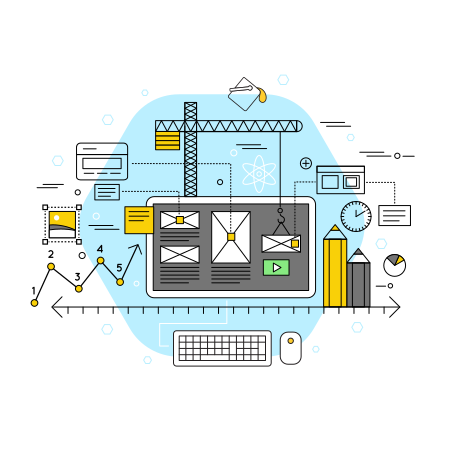
The new approach is Composable ERP. This model breaks the large, complex suite into smaller, independent, and interchangeable modules. These modules are like building blocks. They communicate using modern APIs.
Agility Through Modularity
Composable architecture enables businesses to achieve true agility. They are no longer forced to rely on a single vendor’s timeline for innovation.
- Best-of-Breed Integration: Companies can select the best application for each specific need, such as an advanced inventory management tool or a specialized payroll system. These separate components can integrate easily with the core ERP finance module.
- Faster Innovation: If a company needs a new feature, they can swap out a single module without replacing the entire core system. This drastically speeds up innovation cycles. Gartner reports that organizations using a Composable ERP approach can reduce time-to-market for new features by up to 80%.
- Reduced Vendor Lock-in: The reliance on a single, expensive vendor decreases. Companies gain flexibility, allowing them to adapt to rapid technological shifts.
This shift means ERP is moving from a single product to an ecosystem of services. The core ERP handles the central financial ledger and transactional backbone. Specialized, third-party solutions handle everything else. This provides both stability and flexibility, which is necessary for the modern digital economy.
The Cloud-Native Foundation: Speed and Resilience
The move to the cloud is not a trend anymore. It is the established foundation for modern ERP. Cloud-based ERP systems are the only architecture that can fully support AI integration and composable design. These systems are inherently faster, more flexible, and more resilient than traditional on-premise setups.
The data confirms this dominance. Approximately 70% of the entire ERP market is now cloud-based. Furthermore, the Cloud ERP market is projected to grow at a CAGR of about 12% from 2025 to 2035.
Why Cloud-Native Wins
Cloud-native means the system was built from the ground up for the cloud environment. It uses technologies like microservices and continuous deployment. This grants major operational advantages.
| Feature | Cloud-Native Benefit | Impact on Decision-Making |
| Scalability | Elasticity means resources adjust instantly to match demand spikes. | Supports rapid business growth without system failure. |
| Resilience | Built-in redundancy and automated failover across data centers. | Ensures business continuity during market shocks or local outages. |
| Continuous Updates | The vendor handles security patches and feature releases automatically. | Systems are always current, running the latest AI and security features. |
| Real-Time Data | Data is unified and immediately accessible to all modules and users. | Eliminates data silos and allows for instant, informed decision-making. |
The move to cloud-native platforms is key for organizational resilience. Cloud architecture allows companies to respond rapidly to unexpected market shifts. For example, remote workforce access became a necessity during the pandemic. Cloud ERP systems already supported this flexibility, which allowed operations to continue seamlessly.
The New ERP Goal: Hyper-Automation and Employee Experience
The future of ERP is defined by two related outcomes: maximizing automation and simplifying the user experience. Hyper-automation and better design work together to deliver strategic value.
Hyper-Automation
Hyper-automation is the next step beyond simple process automation. It is the coordinated use of multiple advanced technologies. These tools include AI, Machine Learning, and Robotic Process Automation (RPA).
This coordinated approach automates entire end-to-end business processes. Instead of just automating one task, hyper-automation automates the full workflow from start to finish. For example, it can manage the complete Procure-to-Pay cycle, from generating a requisition to sending the final payment. This reduces manual touchpoints across the business.
Employee Experience (UX)
The new ERP must serve all employees, not just the finance and IT teams. Older systems were often complex, requiring extensive training. Modern ERP prioritizes an intuitive User Experience (UX).

- Personalized Interfaces: AI provides customized dashboards. A sales manager sees different data views than a warehouse supervisor. The interface shows only the most relevant, actionable data.
- Mobile and Voice Access: Employees can access and update the system from any device. This is crucial for field technicians and sales teams who work outside the office.
- Simplified Workflows: The complexity of the underlying system is hidden behind simple, clean interfaces. This dramatically reduces user errors and training time.
By automating repetitive work, ERP frees up human potential. Employees can shift from data entry to more insightful, rewarding work, which directly increases job satisfaction. A user-friendly system ensures high adoption rates, which is necessary to maximize the investment in the new technology.
Frequently Asked Questions (FAQs)
Q. What is the definition of Composable ERP?
Composable ERP is an architectural approach. It replaces a single, massive system with independent, modular components. These components can be assembled, modified, or swapped out easily using APIs. This provides unmatched flexibility.
Q. How does AI specifically help with business decision-making in ERP?
AI changes ERP from reactive to proactive. It uses algorithms to analyze vast data sets in real time. It automatically generates cash flow forecasts, identifies unusual financial anomalies, and optimizes inventory levels. This gives managers intelligence, not just raw data.
Q. What is the role of the Cloud in the future of ERP?
The Cloud is the necessary foundation. Cloud-native architecture provides the massive scalability and low latency required for real-time AI processing. It also enables the continuous, seamless updates that keep composable modules current and secure.
Q. Does a Composable ERP system increase data security risk?
No, it can improve security. Because Composable ERP is modular, a security issue in one component does not compromise the entire system. Furthermore, modern microservices architecture and cloud standards provide superior isolation and advanced security protocols compared to older, monolithic systems.
Ready to Build Your Intelligent ERP Platform?
Bitbyte Technology understands this new ERP engine. We specialize in developing custom, cloud-native ERP solutions. Our systems use modular design and deep AI integration. We help your business move beyond basic automation to achieve a fully hyper-automated and intelligent operation.
Contact us today to discuss how we can engineer a flexible ERP solution that drives your strategic decision-making.