Custom Software vs Off-the-Shelf: 5 Signs Your Business Needs to Switch
Every growing business hits the same wall eventually. The software you chose when you started — the off-the-shelf tool that seemed perfect at the time — starts holding you back. Workflows get hacked together with Zapier automations. Your team exports data into spreadsheets just to make the tool work. Subscriptions keep climbing as your headcount grows.
At that point, a question surfaces that has real consequences: should you build custom software, or keep buying off-the-shelf solutions?
This custom software vs off the shelf guide gives you a clear, honest framework to make that decision — including real cost comparisons, 5 signs you’re ready to go custom, and an honest look at when off-the-shelf is still the right answer.
Not sure which route fits your business? We help growing companies make this call every day. Book a free 30-min discovery call with BitByte →
What Is Custom Software? (And What It Isn’t)
Custom software — sometimes called bespoke software, tailor-made software, or proprietary software — is built from the ground up specifically for your business. The starting point is always your workflow, your data model, your users, and your rules. Nothing is borrowed from a template designed for someone else’s business.
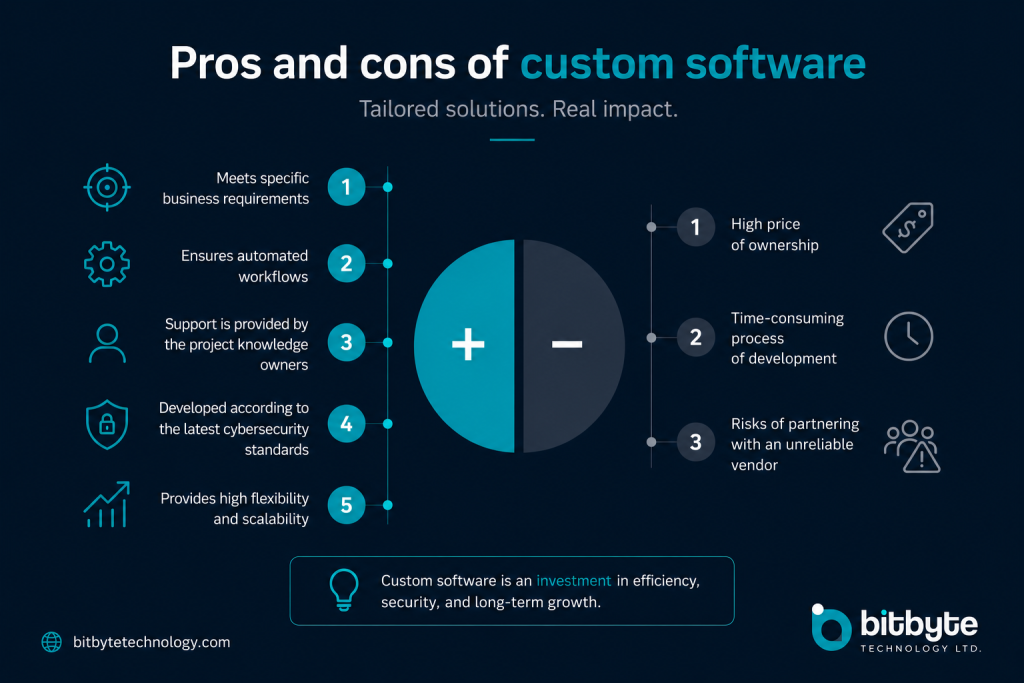
Custom software development can produce anything from a SaaS product to a mobile app, an internal operations platform, a customer portal, or an e-commerce system with logic no off-the-shelf tool supports.
What custom software is not: it is not simply “heavily configuring” Salesforce or adding plugins to Shopify. Those are still packaged products with limits set by the vendor. True custom software means you own the source code, you control the roadmap, and you are not dependent on any vendor’s product decisions or pricing changes.
What Is Off-the-Shelf Software? (COTS Explained)
Off-the-shelf software — also called COTS (Commercial Off-the-Shelf), packaged software, or ready-made software — is pre-built by a vendor and sold to many businesses simultaneously. Think Salesforce for CRM, Shopify for e-commerce, QuickBooks for accounting, Slack for messaging, or Workday for HR.
In 2026, most COTS platforms are delivered as SaaS (Software as a Service) — you pay a monthly or annual subscription to access the software without installing anything on your own servers. The vendor handles updates, security patches, and infrastructure.
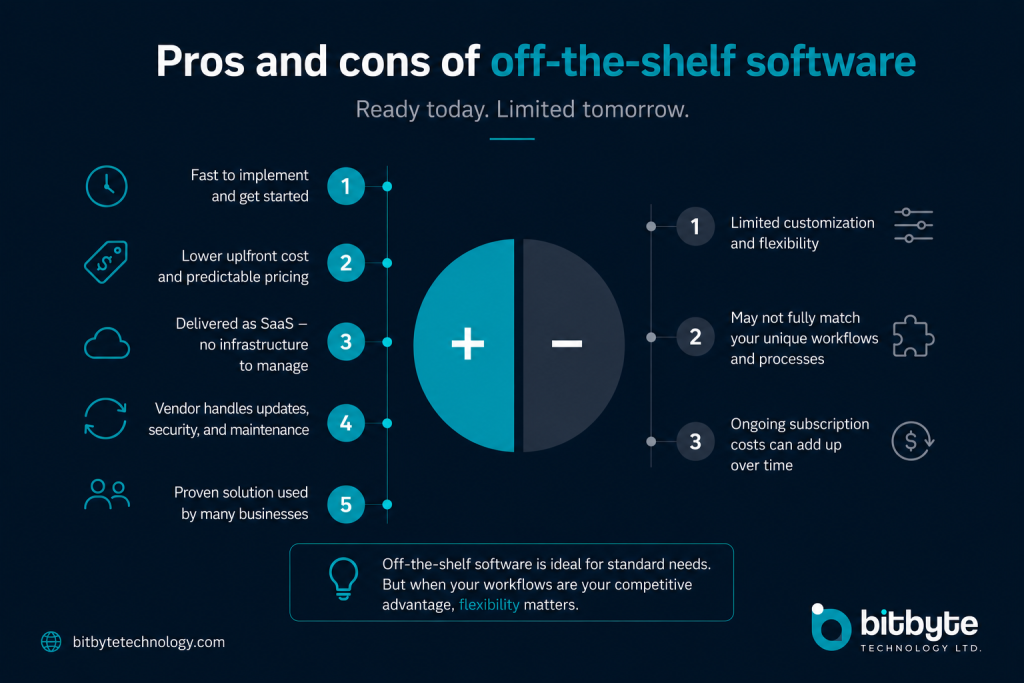
The trade-off is clear: speed and lower upfront cost in exchange for limited flexibility. Off-the-shelf software is designed for the average business, not your business. When your workflows are standard, that’s a good thing. When your workflows are your competitive advantage, it becomes a constraint.
Custom Software vs. Off the Shelf: Side-by-Side Comparison
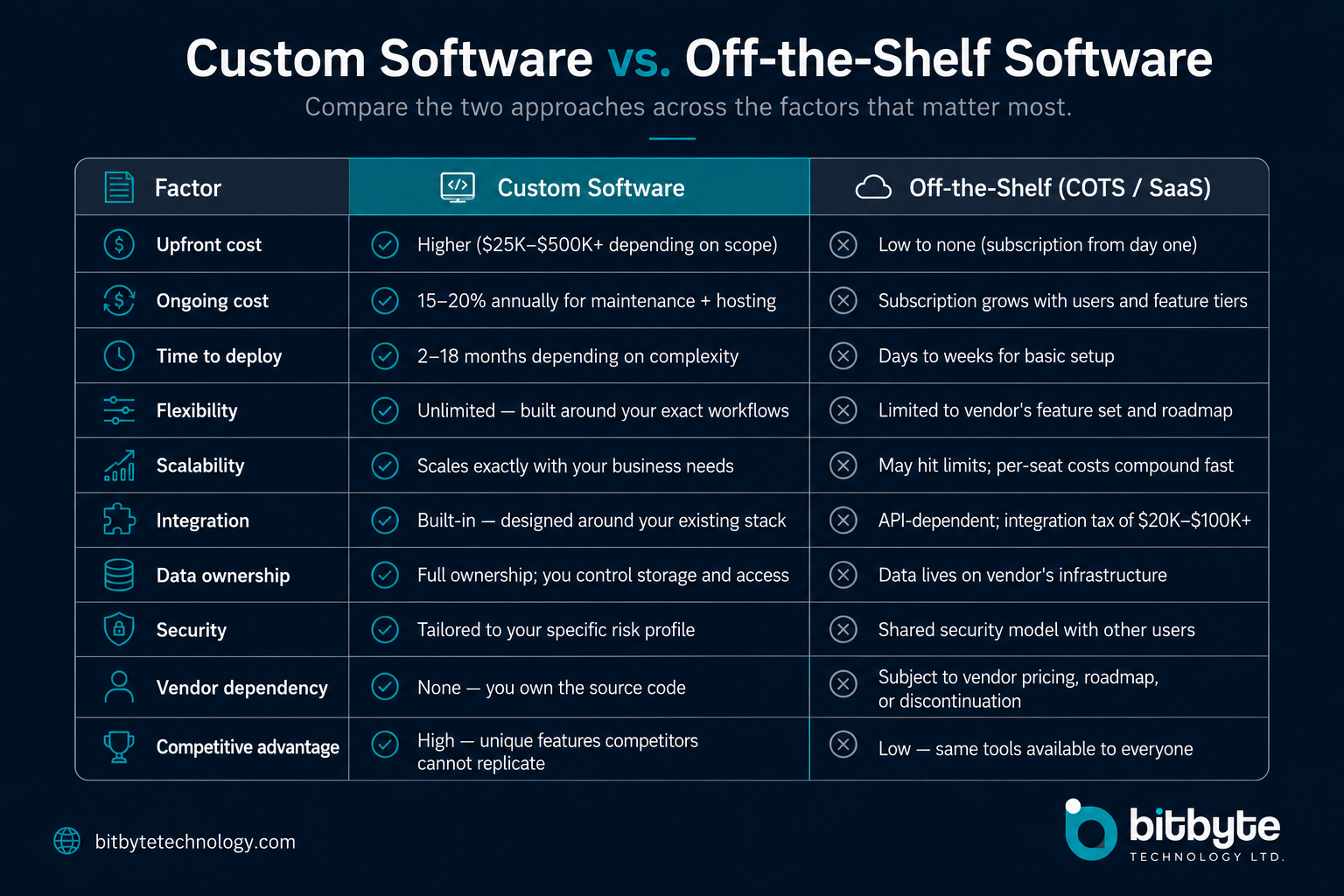
Here is how the two approaches compare across the factors that matter most when making a build vs. buy software decision:
| Factor | Custom Software | Off-the-Shelf (COTS / SaaS) |
|---|---|---|
| Upfront cost | Higher ($25K–$500K+ depending on scope) | Low to none (subscription from day one) |
| Ongoing cost | 15–20% annually for maintenance + hosting | Subscription grows with users and feature tiers |
| Time to deploy | 2–18 months depending on complexity | Days to weeks for basic setup |
| Flexibility | Unlimited — built around your exact workflows | Limited to vendor’s feature set and roadmap |
| Scalability | Scales exactly with your business needs | May hit limits; per-seat costs compound fast |
| Integration | Built-in — designed around your existing stack | API-dependent; integration tax of $20K–$100K+ |
| Data ownership | Full ownership; you control storage and access | Data lives on vendor’s infrastructure |
| Security | Tailored to your specific risk profile | Shared security model with other users |
| Vendor dependency | None — you own the source code | Subject to vendor pricing, roadmap, or discontinuation |
| Competitive advantage | High — unique features competitors cannot replicate | Low — same tools available to everyone |
The Real Cost Comparison: 5-Year Total Cost of Ownership
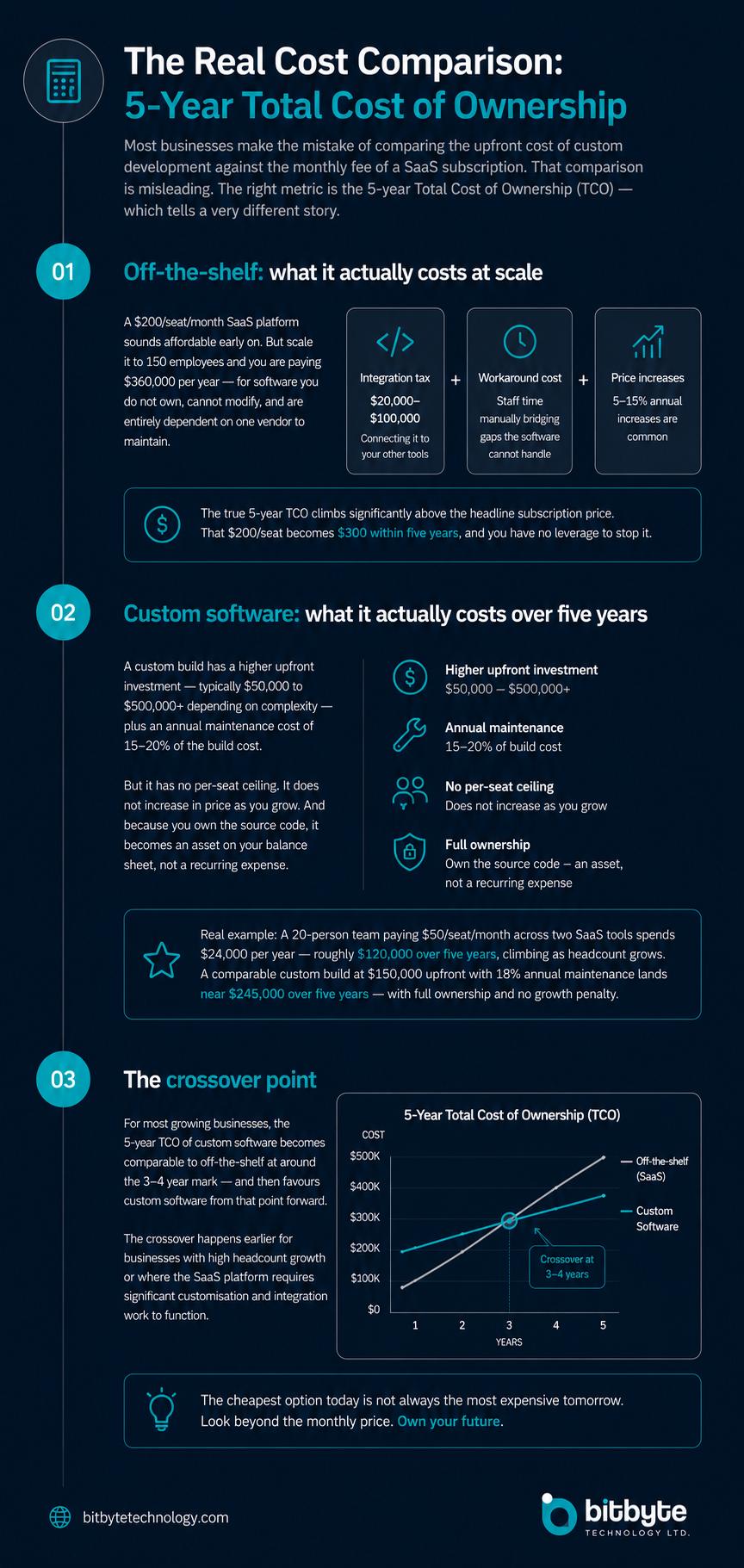
Most businesses make the mistake of comparing the upfront cost of custom development against the monthly fee of a SaaS subscription. That comparison is misleading. The right metric is the 5-year Total Cost of Ownership (TCO) — which tells a very different story.
Off-the-shelf: what it actually costs at scale
A $200/seat/month SaaS platform sounds affordable early on. But scale it to 150 employees and you are paying $360,000 per year — for software you do not own, cannot modify, and are entirely dependent on one vendor to maintain. Add the integration tax (connecting it to your other tools typically costs $20,000–$100,000), and the workaround cost (staff time manually bridging gaps the software cannot handle), and the true 5-year TCO climbs significantly above the headline subscription price.
SaaS vendors also raise prices. Industry data shows annual increases of 5–15% are common. That $200/seat becomes $300 within five years, and you have no leverage to stop it.
Custom software: what it actually costs over five years
A custom build has a higher upfront investment — typically $50,000 to $500,000+ depending on complexity — plus an annual maintenance cost of 15–20% of the build cost. But it has no per-seat ceiling. It does not increase in price as you grow. And because you own the source code, it becomes an asset on your balance sheet, not a recurring expense.
For a real example: a 20-person team paying $50/seat/month across two SaaS tools spends $24,000 per year — roughly $120,000 over five years, climbing as headcount grows. A comparable custom build at $150,000 upfront with 18% annual maintenance lands near $245,000 over five years — with full ownership and no growth penalty.
The crossover point
For most growing businesses, the 5-year TCO of custom software becomes comparable to off-the-shelf at around the 3–4 year mark — and then favours custom software from that point forward. The crossover happens earlier for businesses with high headcount growth or where the SaaS platform requires significant customisation and integration work to function.
5 Signs Your Business Is Ready for Custom Software
Not every business needs custom software. But these five signals are reliable indicators that off-the-shelf is now costing you more than it’s saving you:
- Your team is living in workarounds. If your workflow is “Tool A → Zapier → Tool B → spreadsheet → manual entry,” you are already paying for a custom build in staff time and errors. You are just not getting the actual software.
- Your workflow is your competitive advantage. If the way you handle a process — fulfilment, underwriting, client onboarding, routing, scheduling — is the reason customers choose you, encoding that process inside a generic platform gives that advantage away.
- Subscription costs are becoming a significant budget line. Per-seat pricing compounds fast. When licensing fees reach the level where a one-time build would save money over five years, it is time to run the numbers properly.
- You need integrations that don’t exist or keep breaking. Every API bridge that connects two off-the-shelf tools is a fragility point. When your stack requires three or more brittle integrations to function, a purpose-built system with native data flow is cleaner and cheaper to maintain.
- You’ve outgrown what the platform can do. If you are hitting vendor-imposed limits — feature caps, data limits, API rate limits, or missing functionality the vendor has no plans to build — you are no longer getting value for your subscription.
If three or more of these apply to your business, custom development is likely the right call. Talk to the BitByte team →
When Off-the-Shelf Is Still the Right Answer
Custom software is not always the answer — and a good development partner will tell you that honestly. Off-the-shelf tools are the right choice in specific situations:
- You are an early-stage startup. Use the fastest available tools to validate your product idea and reach your first customers. You can rebuild for scale once you know what you actually need.
- The function is a commodity. Email, payroll, basic accounting, internal messaging — these are not competitive differentiators. Use Slack, QuickBooks, and Xero. Save your custom build budget for the parts of your business that are genuinely unique.
- You need to be live immediately. A well-configured COTS platform can be operational in days. If the timeline is critical and your requirements are standard, buying is the right call.
- Your requirements align well with what’s on the market. If an existing tool does 90% of what you need without significant workarounds, the gap may not be large enough to justify a custom build.
The Hybrid Approach: The 2026 Reality
The most forward-thinking businesses in 2026 are not choosing between custom and off-the-shelf. They are choosing both — deliberately.
The framework is simple: use off-the-shelf for commodity functions, build custom for your competitive advantage.
- Email and internal communication? Slack and Gmail.
- Accounting? Xero or QuickBooks.
- Customer fulfilment platform with proprietary routing logic? Custom build.
- SaaS product you are selling to customers? Custom build.
- E-commerce store with complex pricing, bundles, and personalisation logic that Shopify cannot support? Custom build.
This composable architecture — where a custom API layer connects purpose-built core systems with commodity SaaS tools — gives growing businesses the best of both worlds: speed for standard functions, control for the functions that define them.
AI-native development tools are also changing the economics of this decision. Development timelines for custom software have shortened by 40–60% with modern tooling, making custom builds viable for more businesses and at lower price points than they were even three years ago.
How BitByte Technology Helps You Make This Decision
At BitByte Technology, we build custom software, mobile apps, SaaS platforms, and e-commerce solutions for businesses that have outgrown what generic tools can offer. We also tell clients honestly when an off-the-shelf tool is the smarter call — because a good technology partner is not trying to sell you a build you don’t need.
Our process starts with a discovery call — a free 30-minute conversation where we look at your workflows, your current stack, your growth plans, and your budget, and give you a clear recommendation. Build, buy, or hybrid.
We have built SaaS platforms, AI-powered products, custom e-commerce systems, and mobile applications for clients across the US, UK, and Australia. You can see our work in our portfolio.
Frequently Asked Questions
What is the difference between custom software and off-the-shelf software?
Custom software is built specifically for one business’s unique workflows, users, and goals. Off-the-shelf software is a pre-built product designed for a broad market, sold to many businesses simultaneously. The key trade-off is flexibility and ownership (custom) versus speed and lower upfront cost (off-the-shelf).
Is custom software more expensive than off-the-shelf?
Custom software has a higher upfront investment ($25,000–$500,000+ depending on scope), but no per-seat fees and no vendor price increases. When you calculate the 5-year Total Cost of Ownership — including subscriptions, integrations, and workaround costs — custom software often becomes comparable to or cheaper than SaaS for growing businesses.
What does COTS mean in software?
COTS stands for Commercial Off-the-Shelf software. It refers to pre-built, ready-made applications that businesses can purchase or subscribe to without needing custom development. Examples include Salesforce, Shopify, SAP, and QuickBooks.
Can a business switch from off-the-shelf to custom software later?
Yes. Many businesses start with off-the-shelf tools and migrate to custom software as they scale and their requirements grow more complex. A phased migration — building custom around your core workflows first, while keeping commodity SaaS for standard functions — is a common and effective approach.
Is there a hybrid approach between custom and off-the-shelf software?
Yes — and it is the approach most successful growing businesses use in 2026. The principle is simple: use off-the-shelf tools for commodity functions (email, accounting, payroll) and invest in custom development for the specific workflows and products that differentiate your business from competitors.